

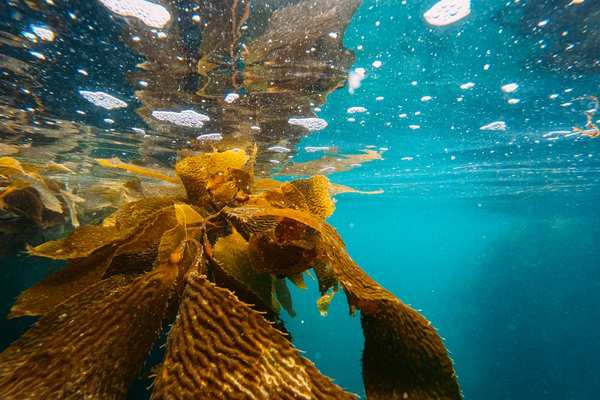
Off the Pacific coast, what looks from the surface like floating seaweed can be an underwater neighborhood. Below the canopy, fish weave between golden blades, crabs shelter among rocks, and sea urchins graze the bottom. Kelp forest ecosystems turn cool coastal waters into some of the ocean’s most productive habitats.
These forests are familiar along parts of the US West Coast, from Alaska to California. Their importance goes beyond the kelp itself: the forest creates shelter, supplies food, and changes according to the balance between predators and grazers.
How an Underwater Forest Takes Shape
Kelp is a large brown alga, not a tree or flowering plant. It photosynthesizes, while a rootlike holdfast grips rock rather than drawing nutrients from soil. Flexible stems called stipes support leaflike blades. In some species, gas-filled floats lift the blades toward brighter water.
The largest forests need firm seafloor for attachment, sunlight for growth, and cool water carrying dissolved nutrients. This explains why kelp thrives on many rocky shores but not on every beach or in deep, dark water.
Giant Kelp and Bull Kelp
Two Pacific species give these habitats different appearances. Giant kelp can form dense canopies supported by numerous blades and floats. Bull kelp typically grows a long stalk topped by one large float and a cluster of blades. Bull kelp commonly completes its life cycle within a year, while giant kelp may survive for several years under suitable conditions.
Both can grow rapidly when conditions are favorable. Yet storms can tear out mature plants, and seasonal changes may reshape an entire canopy.
One Forest, Several Distinct Habitats
Calling kelp habitat a single environment misses its defining feature: animals use different levels of the same forest. That vertical structure makes a small stretch of rocky coastline useful to many species.
The Surface Canopy
Floating blades filter sunlight and create cover. Sea otters may rest among the kelp, wrapping themselves in it to reduce drifting. Small fish shelter beneath the canopy, while seabirds hunt prey around its edges.
The Midwater Zone
Below the canopy, swaying stipes and blades provide hiding places. Juvenile rockfish and other fish seek refuge here, while larger fish hunt smaller animals. The cover matters because survival often depends on staying out of sight.
The Rocky Seafloor
Holdfasts and rocks host snails, crabs, brittle stars, anemones, and sea stars. Some graze algae; others capture passing food or scavenge organic material. Urchins also live here, and their feeding can have consequences for the forest above.
How the Kelp Forest Food Web Works
The kelp forest food web begins with primary producers. Kelp and smaller algae capture solar energy and turn it into organic material. Microscopic phytoplankton add another source of production. Energy then moves through overlapping pathways rather than one tidy chain.
Some animals eat living algae. Sea urchins and snails graze kelp or smaller seaweeds, while herbivorous fish feed on available algae. Others benefit when kelp blades break off and drift away. Crustaceans, worms, and other detritus feeders consume fragments or material associated with their breakdown.
Predators connect those pathways. Rockfish eat smaller fish and invertebrates; sea stars consume bottom-dwelling prey; seals and sea lions hunt fish. Sea otters are influential where they eat urchins. Even an animal that never bites kelp may depend on the food and shelter it provides.
This is why marine food webs are networks. A change in one species can influence several others, including animals with no direct feeding relationship to it.
Why Sea Urchins Can Change Everything
Urchins are natural forest residents, not invaders to remove automatically. In balanced communities, many shelter in crevices and feed on drifting algae. Trouble begins when dense populations graze standing kelp, sometimes chewing through young plants or holdfasts.
Heavy grazing can turn a leafy forest into an urchin barren: rocky bottom with little kelp. Losing the canopy means losing shelter and nursery habitat for other kelp forest animals. Remaining urchins may prevent recovery by eating new growth.
The sea otter–urchin–kelp relationship illustrates a trophic cascade: a predator indirectly benefits kelp by limiting grazers. But local outcomes vary. Sunflower sea stars, spiny lobsters, and certain fish also influence urchins in different regions. Predator loss, disease, warm-water stress, and grazing can reinforce one another.
Why These Coastal Ecosystems Matter
Kelp forests support species that also use nearby reefs, open water, and sandy habitats. Many fish spend only part of their lives in the forest, so healthy kelp beds support ecological connections beyond their visible boundaries.
They also support diving, wildlife watching, research, and some fisheries. Their growth absorbs dissolved carbon during photosynthesis, although long-term carbon storage depends on where detached kelp eventually ends up.
Pressures include marine heatwaves, strong storms, sediment runoff, pollution, and excessive grazing. Warmer water can coincide with reduced nutrient supplies, slowing growth. Because conditions differ by coastline, scientists monitor canopy extent, temperature, grazers, and predators together.
Reading a Kelp Forest From Shore
From a safe, publicly accessible California headland, look for floating brown canopy patches beyond rocky reefs. Compare sightings across seasons or after storms. A thinner canopy does not automatically prove permanent decline: seasonal growth and storm damage are normal. Repeated observations alongside local marine sanctuary monitoring reports tell a fuller story.
When kayaking or snorkeling, avoid pulling plants, disturbing wildlife, or dragging equipment through kelp. Understanding ocean upwelling and sea otter conservation can also help explain changes you observe.
Frequently Asked Questions
Where are kelp forest ecosystems found?
They occur mainly along cool, nutrient-rich, rocky coastlines in relatively shallow water. Important US examples lie along the Pacific coast, including California, Oregon, Washington, and Alaska.
What animals live in kelp forests?
Residents and visitors include rockfish, kelp bass, sea urchins, crabs, snails, sea stars, sea otters, seals, sea lions, and feeding seabirds. Species vary by location, depth, and season.
Why do kelp forests need sunlight?
Kelp uses photosynthesis to grow. Light weakens with depth and murky water, so forests form where enough sunlight reaches their blades.
Can a damaged kelp forest recover?
Yes, when conditions improve and young kelp can establish. Recovery may remain difficult where persistent urchin grazing, repeated heatwaves, or poor water quality prevent new growth.
A Living Habitat, Not Just Seaweed
The remarkable part of kelp forests is not just their height. Their growth creates shelter for fish, food for grazers and detritus feeders, and hunting grounds for predators. Protecting these coastal ecosystems means recognizing those connections, from sunlight and ocean nutrients to the smallest invertebrates and the largest visitors beneath the canopy.
