

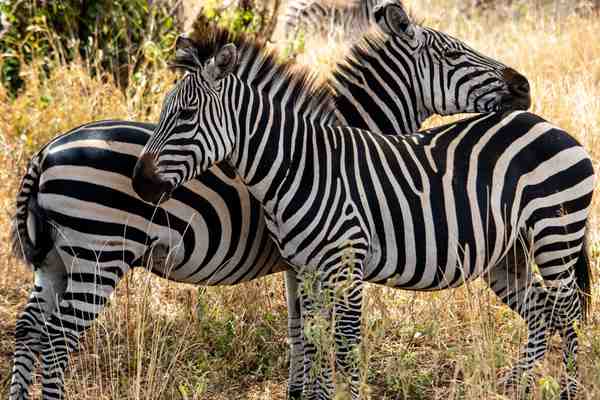
A zebra standing in open grassland hardly seems dressed for secrecy. Its black-and-white coat stands out to human eyes, especially when several animals gather together. So why do zebras have stripes? The most convincing scientific answer is surprisingly small: biting flies. Research suggests the bold pattern makes it harder for certain blood-feeding insects to land successfully.
Scientists have also investigated camouflage, predators, cooling and social recognition. Comparing these ideas reveals something fascinating about evolution: a striking feature does not need to look useful to us to work for the animal wearing it.
The strongest evidence: stripes discourage biting flies
Horseflies and related biting insects are more than a passing nuisance. Their bites can cause irritation, interrupt grazing and sometimes contribute to disease transmission. For an animal spending hours outdoors, even a modest reduction in successful attacks could matter over a lifetime.
The zebra stripe purpose supported most consistently by research is to reduce landings by certain biting flies, particularly horseflies. A 2014 study in Nature Communications compared striping across living horse relatives and their environments. Stronger striping was associated with conditions where biting flies were more likely to be active, rather than consistently with predator presence or temperature.
What happened when horses wore striped coats?
A particularly revealing experiment, published in PLOS ONE in 2019, observed zebras and domestic horses in Britain. Horseflies approached both animals, but landed successfully on zebras less often. Researchers then dressed horses in striped, black or white fabric coats.
Flies landed substantially less often on the striped coverings. Crucially, the same horses’ uncovered heads did not gain that protection. The experiment helped isolate the visual effect of the coat from differences in smell, movement or species.
Imagine a fly approaching a horse wearing a zebra-pattern rug. It can detect the animal and fly towards it, yet its final landing is less likely to succeed on the striped fabric. This is a better picture of the evidence than the common claim that stripes make zebras invisible to insects.
Further field tests support the connection
In experiments in Kenya reported in 2022, researchers found that biting stable flies preferred landing on plain impala hides over striped zebra hides. That strengthens the case that the effect is not restricted to domestic horse coverings or one particular fly experiment.
How do black-and-white stripes affect a fly?
This is where the science of zebra patterns becomes more complicated. Researchers broadly agree that conspicuous stripes can reduce landings by some flies, but they continue to investigate the visual explanation.
One proposal is that alternating lines interfere with a fly’s ability to judge motion and distance as it slows down to land. In the 2019 observations, approaching horseflies sometimes failed to decelerate properly before reaching zebras. That finding suggests a problem during the final approach, rather than simple failure to notice the animal.
Other experiments have challenged particular versions of this motion-confusion explanation. A 2023 study in the Journal of Experimental Biology found that strong contrast and relatively small dark patches helped discourage horsefly landings. Large uninterrupted dark areas appeared more attractive. The evidence did not clearly support polarized light as the main explanation.
These results point towards a useful distinction: scientists have good evidence for the effect, but less certainty about exactly how the insects process the pattern. A plausible mechanism is not yet the same thing as a fully demonstrated one.
Does zebra camouflage protect them from lions?
Zebra camouflage is an appealing theory. Perhaps the stripes break up a body’s outline among tall grass, or a moving herd creates confusing overlapping lines. Both ideas sound reasonable when viewed from a human perspective.
Yet a predator does not necessarily see the scene as we do. Lions and hyenas have different visual abilities, and stripes become difficult to resolve from a distance. At closer range, movement, scent and other cues can reveal prey. Comparative research has not found consistent evidence that predator pressure best explains why zebras evolved their coats.
Can stripes keep a zebra cool?
Another longstanding idea involves heat. Black hairs absorb more sunlight than white hairs, so researchers have asked whether adjacent warm and cool surfaces create tiny air movements that help release heat.
That possibility is not entirely unreasonable, but experiments have not established stripes as an effective whole-body cooling system. A 2018 Scientific Reports study used sun-exposed, hide-covered barrels and found no significant core-temperature advantage for striped coverings over grey ones. Such models cannot reproduce every aspect of living-animal physiology, but they weaken a simple cooling claim.
Do stripes help zebras recognize one another?
No two zebras have precisely identical stripe arrangements, making the markings useful to human researchers photographing and identifying individuals. It is tempting to assume zebras use the same visual details to recognize family members.
They might use coat patterns as one cue, but individual recognition has not been shown to be the primary reason stripes evolved. Zebras also communicate through sound, smell, body posture and familiarity. The fact that a pattern is individually distinctive does not prove that natural selection produced it for identification.
Why are zebra stripes different across species?
Plains, mountain and Grevy’s zebras have recognizably different patterns. Stripe thickness and spacing also vary across body regions and populations. Scientists study this variation to test whether particular environments consistently favour different markings.
However, not every difference needs one neat explanation. Coat patterns develop through complex biological processes, and several evolutionary pressures may influence their details. Research in Kenya found that zebra hides with different stripe widths were similarly effective against the stable flies tested, suggesting that biting flies alone may not explain every variation.
Frequently asked questions
Are zebras black with white stripes or white with black stripes?
Zebras generally have dark skin beneath their coats. The visible black-and-white pattern comes from differences in pigment production in the hair. Saying they are simply one colour painted with the other is less informative than understanding how their coat develops.
Do zebra stripes stop all flies from biting?
No. Experiments show fewer successful landings by certain biting flies on striped surfaces, not complete immunity from insects. Zebras still rely on tail movements and other defensive behaviours.
Do stripes confuse lions when zebras run together?
That idea has been proposed, but direct evidence that herd stripes reliably confuse hunting lions is weak. Fly deterrence has substantially stronger experimental support.
Is every zebra’s stripe pattern unique?
Individual stripe arrangements vary enough that researchers can often identify zebras from photographs. Whether zebras depend heavily on those differences for social recognition remains uncertain.
What zebra stripes teach us about evolution
The answer to why zebras have stripes is less about hiding from large predators and more about frustrating much smaller attackers. Studies of live animals, striped horse coats and natural hides all support a protective effect against certain biting flies. Exactly how the lines interfere with insect landings is still being refined.
That makes the zebra an excellent reminder that an adaptation should be judged by evidence, not appearances. What looks conspicuous to us may be precisely what makes life harder for a fly.
