

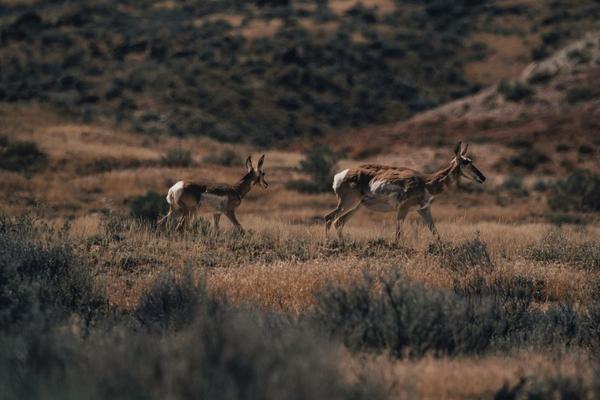
A pronghorn standing in a Wyoming sagebrush flat might look like an unusually slender deer. Watch it run, however, and the resemblance quickly fades. This animal can race across open ground, spot distant danger, and follow seasonal routes stretching across vast western landscapes. The most fascinating pronghorn facts tell a connected story: extraordinary speed works because pronghorns evolved for wide, relatively unobstructed country.
Pronghorns Are Not True Antelope
Although often called American antelope, pronghorns (Antilocapra americana) are neither true antelope nor deer. They are the only surviving members of the family Antilocapridae, an ancient group that evolved in North America. Their distinctive appearance reflects that separate history.
Pronghorns have long legs, tan to reddish-brown coats, and bright white markings on the throat, belly, and rump. Adults stand roughly three feet tall at the shoulder. Males typically have prominent black cheek markings and larger horns, while females have smaller horns or sometimes barely noticeable ones.
Their Horns Are Unusual
A male’s horns typically curve backward and have forward-pointing prongs. Unlike deer antlers, they grow around permanent bony cores. Unlike the permanent outer horns of cattle, however, the pronghorn’s keratin sheaths are shed and replaced, generally every year. That combination is a distinctive feature of this species.
How Fast Can a Pronghorn Run?
Pronghorn speed can approach 55 miles per hour (89 kilometers per hour) in a sprint. That makes the species North America’s fastest land mammal. Exact recorded speeds differ among accounts and conditions, so the figure is best understood as an approximate peak rather than a pace every animal can maintain.
The greater surprise is endurance. Pronghorns can sustain high speeds over much longer distances than many sprinters. Long legs, light bodies, efficient movement, and powerful respiratory and circulatory systems help them keep running across open terrain.
Why Did Pronghorns Become So Fast?
Scientists have proposed that their remarkable running ability evolved partly in response to swift prehistoric predators, including the extinct animal often called the American cheetah. This remains a hypothesis, not a proven explanation. Today, speed gives pronghorns a useful advantage when escaping coyotes and other predators.
They rarely rely on speed alone. Large, widely positioned eyes help them monitor a broad field of view. Spotting trouble early leaves time to escape before an encounter becomes dangerous.
Pronghorn Habitat: Life Under an Open Sky
Typical pronghorn habitat includes grasslands, sagebrush steppe, high-desert basins, and other open landscapes. Their range extends across parts of the western United States, southern Canada, and northern Mexico. These places offer both long sightlines and plants that support the animals through changing seasons.
Open habitat does not mean barren habitat. A healthy patchwork of shrubs, grasses, and flowering plants supplies food at different times of year. Pronghorns also need room to move between those patches. Roads, dense development, and restrictive fences can separate animals from otherwise useful land.
Compare this strategy with a forest-dwelling deer that may escape into cover. A pronghorn is adapted to notice danger early and run across open space. Its habitat is an essential part of its defense.
What Do Pronghorns Eat?
The pronghorn diet includes sagebrush, other shrubs, forbs, and grasses. Forbs are broad-leaved flowering plants that grow among grasses. The balance changes by season and region, and pronghorns select forage according to availability and nutritional value.
Pronghorns are ruminants. They regurgitate and rechew partially digested food, allowing their digestive systems to extract nutrients from tough vegetation. In dry areas, plants can supply much of their moisture, although water requirements vary with conditions.
This makes plant diversity important. Open land with poor forage cannot support a herd simply because there is room to run. Food quality and landscape connectivity matter together.
Pronghorn Migration: A Journey Across the West
Pronghorn migration is among the remarkable wildlife movements of western North America. Some populations stay within a limited area all year, while others travel between seasonal ranges to find food and avoid deep snow. Not every pronghorn migrates.
One well-known route connects the Grand Teton area with Wyoming’s Upper Green River Basin. Some animals travel approximately 150 miles each way. Their path crosses ranchland, public land, highways, and fence lines rather than remaining inside a single protected park.
Why Can a Fence Stop a Pronghorn?
Although capable of jumping, pronghorns usually prefer moving under fences. Low woven wire or closely spaced bottom strands may block a traditional route. During snowy winters, these obstacles can prevent animals from reaching vital feeding areas.
Wildlife-friendly fencing and protected corridors help address the problem. Conservation projects in Wyoming have modified restrictive fences to create passages beneath them. These connections allow animals to reach the habitats they need at different times of year.
Herds, Fawns, and Warning Signals
Pronghorn social behavior changes with the seasons. Smaller groups often spread across summer habitat, while larger herds may gather outside the breeding season. During the fall rut, males compete for access to females.
Females typically give birth in late spring and often have twins. Newborn fawns initially depend on camouflage and remaining still rather than trying to outrun predators. Their mothers return to nurse them, and the young gradually become more mobile.
Another adaptation is the white rump patch. When a pronghorn becomes alarmed, its rump hairs can stand up, creating a conspicuous visual signal to other animals. Herdmates may notice the warning before they identify the threat themselves.
Seeing Pronghorns Responsibly
In open country around Grand Teton or the western plains, look across sagebrush flats with binoculars, especially when animals are feeding. Stop only at designated or legal pullouts, remain at a respectful distance, and watch for the white rump patches that make pronghorns easier to identify.
Never chase or deliberately startle one to photograph its speed. A sudden sprint wastes energy, particularly during winter or migration. If animals approach a crossing, leave space and let them move without interference.
Frequently Asked Questions
Are pronghorns faster than cheetahs?
No. Cheetahs can achieve higher peak speeds, while pronghorns are notable for maintaining fast running over longer distances.
Where are pronghorns found?
They inhabit open grasslands, sagebrush landscapes, and deserts in western North America, including the United States, Canada, and Mexico.
Do all pronghorns migrate?
No. Some herds travel long seasonal routes, while others can meet their needs within smaller year-round ranges.
Do pronghorns lose their horns?
They shed the outer horn sheaths but retain the underlying bony cores. Deer, by contrast, shed their antlers entirely.
A Species Defined by Open Country
Pronghorns are exceptional runners, but their survival depends on more than speed. Healthy forage, clear sightlines, and connected migration routes are all part of the same adaptation to western landscapes. Protecting those features helps preserve a uniquely North American mammal whose story is still unfolding across the plains.
