

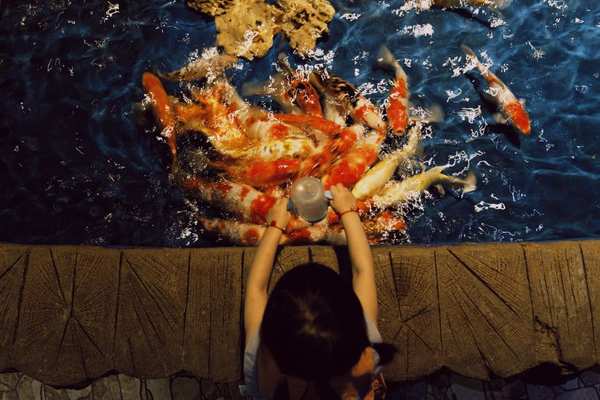
Goldfish can make a convincing case for another meal. They gather at the glass, follow your movements and eagerly search for food even after eating. That enthusiasm is charming, but it is not a reliable measure of hunger. Feeding well means considering both the fish’s nutrition and what uneaten food does to the water.
This goldfish feeding guide covers suitable foods, practical portions and daily schedules without treating every hungry-looking fish as an emergency.
Make complete goldfish food the foundation
Goldfish are omnivores, eating both plant and animal material. For a home aquarium, the simplest foundation is a commercially prepared food labelled as nutritionally complete for goldfish. It provides a more dependable balance of nutrients than vegetables or treats alone.
Pellets, flakes and gel food
Pellets are easy to portion, especially when they are small enough for each fish’s mouth. Sinking varieties can be particularly helpful for round-bodied fancy goldfish, which sometimes struggle with surface feeding. They also let slower fish forage below the waterline.
Flakes are another suitable option when formulated for goldfish, although fragments may drift into the filter or collect beneath decorations. Complete prepared gel foods can work too. Read the package directions: a large pellet, tiny granule and soft gel portion do not contain equivalent amounts of food.
Keep dry goldfish food sealed, cool and dry. Replace stale food rather than relying on an oversized tub indefinitely.
Use vegetables and treats for variety
Small pieces of softened zucchini, spinach or cooked, shelled peas can add variety to a goldfish diet. Cool cooked vegetables before offering them, and remove leftovers before they decay. Thawed frozen daphnia or brine shrimp are occasional protein-rich treats, not replacements for a complete staple.
Avoid bread, seasoned leftovers, fatty mammal meat and routinely substituting tropical-fish flakes. For more ideas about variety without excess waste, safe vegetables for aquarium fish is a useful related topic.
How much food does a goldfish need?
There is no universal pellet count. A small juvenile, large common goldfish and slow-moving fancy goldfish have different requirements, while brands vary in pellet size and energy content. Follow the manufacturer’s guidance as a starting point, then observe your fish and the aquarium.
For an established adult, begin with a modest amount consumed promptly, generally within about two minutes. This is an observation tool rather than a rigid nutritional formula. Avoid adding more just because the fish continues to beg.
Try measuring a small serving into a clean, dry spoon before opening the tank lid. Watch how much each fish eats. If several pellets remain on the gravel, reduce the next meal. If one fish takes everything, divide the same portion between two feeding locations rather than automatically doubling it.
Reassess over time. Growth, body condition, appetite and waste levels tell you more than a single enthusiastic feeding session. Sudden swelling or weight loss merits investigation instead of an immediate increase or decrease in food.
How often to feed goldfish
One small daily feeding is a reasonable routine for many healthy adult goldfish in a stable indoor aquarium. Others do well when the appropriate daily amount is split into two smaller meals. What matters is the total ration, not the number of times the lid opens.
Young, actively growing goldfish may need smaller meals more frequently, using food suited to their age. Sick or recovering fish may require an individual plan from an aquatic veterinarian.
A simple daily routine
Suppose you keep one energetic common goldfish with a slower fancy goldfish. In the morning, offer a few suitably sized sinking pellets in one area, then place the rest where the slower fish can reach them. Observe both fish. If you choose a second evening feeding, split the daily ration between the two meals rather than providing two full portions.
Maintain a fairly consistent schedule. A fish suddenly refusing food or swimming differently is a reason to check water conditions and health, not to tempt it with larger servings.
Adjust for cold pond water
Goldfish metabolism slows as water cools. Outdoor feeding should reflect measured water temperature and fish activity, not only the season. Reduce portions substantially in cold conditions; near 8°C, routine feeding may need to stop or be severely restricted. Follow advice appropriate to the pond and feed being used.
Why overfeeding harms water quality
Goldfish overfeeding affects more than body condition. Uneaten food decomposes, while digested food produces waste. Both increase the burden on the aquarium’s biological filter. Beneficial bacteria convert toxic ammonia into nitrite and then nitrate, but an immature or overloaded filter may struggle to process the additional waste.
Test ammonia and nitrite regularly, especially in newly established tanks or after feeding changes. Both should normally be undetectable in a properly cycled aquarium. Track nitrate as well, use adequate filtration and perform suitable partial water changes with conditioned water. Clear-looking water does not guarantee safe water chemistry.
Food rotting beneath ornaments, lingering pellets and cloudy water after meals call for smaller portions and water checks. If ammonia or nitrite is elevated, address the water-quality problem promptly. Understanding the aquarium nitrogen cycle makes these test results much easier to interpret.
Feeding habits worth avoiding
Responding to every begging display is a common mistake. Goldfish quickly associate people with food. Another is scattering a big pinch into a shared tank and assuming each fish receives an equal share. Watch the slowest or shyest fish instead.
Do not leave vegetables or thawed treats sitting overnight. Introduce new foods gradually so changes in appetite and waste are easier to identify. And remember that persistent floating, sinking or bloating is not always caused by diet; buoyancy difficulties can have several causes and deserve veterinary assessment. Recognising goldfish health problems is a helpful related subject.
Frequently asked questions
Can goldfish eat every day?
Yes. Healthy indoor adults generally receive a modest daily ration. Cold-water pond fish are an exception because their metabolism and feeding needs slow with falling temperatures.
Are flakes or pellets better for goldfish?
Either can work if formulated as complete goldfish food. Small sinking pellets are especially convenient for many fancy goldfish. Choose what your fish can eat without leaving excessive debris.
Why does my goldfish always seem hungry?
Goldfish learn to approach the person who feeds them. Begging alone does not mean another meal is necessary. Use consistent portions, body condition and water tests to judge your routine.
What if I accidentally add too much food?
Remove visible leftovers, test ammonia and nitrite, and check filtration. Respond to abnormal water results with appropriate aquarium maintenance instead of simply waiting for the food to disappear.
A steady routine beats generous handfuls
The best approach is easy to repeat: a complete goldfish food, sensible portions and occasional carefully chosen extras. Watch every fish eat, remove leftovers and treat water testing as part of feeding. These small habits support both a balanced diet and a healthier aquarium.
