

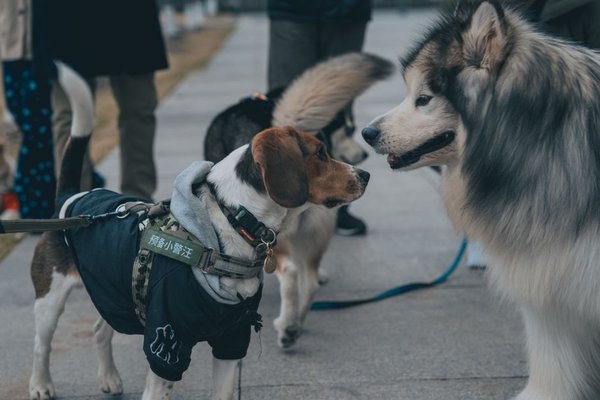
For a reactive dog, “socialization” should not mean meeting as many dogs and people as possible. The safer goal is quieter: helping your dog notice a trigger, stay within a manageable emotional range, and learn that nothing bad is about to happen. That distinction matters for rescue and shelter dogs whose history may be unknown and whose barking, lunging, freezing, or retreating can come from fear, frustration, overexcitement, or mixed emotions.
Good dog reactivity training is built around controlled exposure, distance, choice, and rewards. A dog calmly watching another dog from across the street can be a major success.
Redefine what successful socialization looks like
A reactive dog does not need to enjoy close contact with every stranger or dog. Your first target should be neutrality: seeing a person, dog, bicycle, child, or other trigger without escalating into panic or explosive behavior.
Identify what triggers your dog and at what distance. Watch for early changes such as a closed mouth, fixed stare, stiff posture, pinned ears, slowing down, trying to leave, or sudden scanning. Barking and lunging often happen after subtler signs have appeared. Spotting them early gives you time to create space.
If reactivity appears suddenly, worsens quickly, or comes with signs of pain or illness, speak with a veterinarian. Dogs with a bite history, severe aggression, or reactions that are difficult to control are best supported by a qualified, reward-based behavior professional.
Work below your dog’s reaction threshold
Desensitization exposes a dog to a trigger at an intensity low enough that the dog can cope. Counterconditioning pairs that trigger with something the dog values, often high-value food. Used together, these methods can gradually change how the dog feels about the trigger rather than simply suppressing outward behavior.
Distance is usually the easiest variable to control. If your dog reacts to other dogs at 20 metres, begin farther away. The moment your dog notices another dog, calmly offer a small, excellent treat. When the other dog disappears, the treats stop. Over repeated sessions, the sight of another dog begins to predict something positive.
If your dog freezes, stares intensely, refuses food they normally love, pulls hard toward or away from the trigger, barks, or lunges, increase the distance. That is useful information, not a failed session.
Use a step-by-step plan instead of forced greetings
Build easy skills away from triggers
Practice simple behaviors in calm places first: responding to their name, turning with you, checking in, following a hand target, and making a relaxed U-turn. These skills become useful exits when leash reactivity starts to build.
A useful related topic is dog body language signals, because owners who can spot tension early are more likely to intervene before a reaction.
Create controlled exposure sessions
Choose a place with room to move away, such as a wide park edge or quiet car park perimeter. Keep sessions short. One calm exposure followed by a sniffing break can be more productive than repeatedly pushing the dog close to triggers.
For fearful dog socialization around people, ask helpers to ignore the dog at first. No staring, reaching, leaning over, or trying to pet. The person can stand sideways at a comfortable distance while you reward your dog for noticing them calmly. The dog should approach only if they choose to and remain relaxed.
Introduce dogs through distance and movement
Skip crowded dog parks and head-on leash greetings while your dog is reactive. A better first setup is a parallel walk with one calm, socially appropriate dog and an experienced handler. Start far enough apart that both dogs can walk, sniff, and take treats comfortably. Reduce the distance over multiple sessions only if your dog stays loose and responsive.
Loose-leash walking is another natural internal linking opportunity because leash tension can make difficult encounters harder to manage.
What a real training session can look like
Imagine your rescue dog, Milo, barks at men during walks. He begins staring when a man is about 15 metres away. Instead of asking a friend to approach and offer his hand, you start 25 metres away. Milo sees the friend, then receives several small pieces of chicken. The friend turns and walks away, and the food stops.
After a few repetitions, Milo sees the friend and looks back at you for his reward. That check-in is progress. On another day, you work at 22 metres. If Milo becomes stiff, return to 25 metres. The plan follows Milo’s comfort, not a timetable.
Avoid methods that can make reactivity worse
Do not flood a reactive dog by forcing prolonged close exposure until they “get used to it.” Overwhelming experiences can increase fear. Avoid leash corrections, intimidation, shouting, or aversive equipment intended to punish reactions. Punishment may stop behavior in the moment without improving the underlying emotion and can make a trigger feel more threatening.
Do not punish growling either. A growl is valuable communication that your dog is uncomfortable. Create distance and review what made the situation too difficult.
If there is a genuine bite risk, safety management comes before exposure work. A well-fitted basket muzzle can add protection when introduced gradually and positively, but it should never be used to force a dog into situations they cannot handle.
Support progress between sessions
Reactive dogs often benefit from quieter walks, sniffing opportunities, predictable routines, adequate rest, and enrichment that does not keep them constantly aroused. Mental enrichment for anxious dogs is a useful related topic because decompression and choice can support better learning.
Track the trigger, approximate distance, your dog’s first signs of tension, whether they could eat and respond to you, and how quickly they recovered.
Frequently asked questions
Can a reactive dog ever be fully socialized?
Many reactive dogs improve substantially, but the outcome varies with temperament, history, triggers, health, and training. Success does not have to mean becoming highly social. Calm neutrality and safe management can be excellent outcomes.
Should I let my reactive dog meet other dogs on leash?
Usually not as a first exercise. Tight leashes, restricted movement, and face-to-face approaches can add pressure. Controlled parallel walking at a comfortable distance is often a safer starting point.
How long does reactive dog socialization take?
There is no fixed schedule. Mild cases may improve within weeks, while fearful or long-standing reactions can require months of gradual work. Progress is rarely perfectly linear, so adjust distance and difficulty based on the dog in front of you.
What should I do if my dog reacts during training?
Create distance calmly, allow time to recover, and make the next repetition easier. Do not punish the reaction. If reactions are frequent or severe despite careful management, get professional help before increasing exposure.
Build confidence, not forced friendliness
Learning how to socialize a reactive dog safely is mostly about changing the emotional meaning of everyday encounters. Give your dog enough distance to think, pair triggers with positive outcomes, keep sessions controlled, and treat neutrality as a win. With patient, reward-based practice and sensible management, many reactive dogs can move through the world with less stress and more confidence—even if they never want to greet everyone.
